Skip to content
Sun Software logo with the tagline Engineering Beyond Code
Telehealth Companies

Telemedicine software development that takes a patient from sign-up to first visit.

In online care, the gap between a card payment and a first visit is where patients go quiet. That gap is the part of telemedicine software development we do: we join your sign-up page, payment, intake form and clinician calendar, so a new patient is enrolled and booked with the right clinician while they are still on your site.

What the research says

Starting online care is where patients get stuck.

A US consumer survey, a published study of one online psychiatry practice and a federal health survey show how many patients hit a problem or leave early. Two regulator cases show what goes wrong at sign-up itself.

The problem

Where does a new patient stall between paying and being seen?

Most telehealth companies start with a payment tool, a form tool, a calendar and a founder who ties them together each morning. That works for the first fifty patients. You may recognise some of these.

01

A patient pays at 11pm and waits until morning for an account and a time

02

Paid patients never pick a first visit, and nobody notices for a week

03

Intake answers are copied from a form tool into your care platform

04

Someone matches each patient to a clinician by state licence, from a spreadsheet

05

Visit times show in the clinician's time zone, not the patient's

06

Billing, rescheduling and login messages share one inbox with clinical ones

One plan, several services

Who does what on your project?

Your patient sees one thing: they paid, answered some questions and got a time with a clinician. Behind that are a page, a payment, a form, a set of calendars and a search result. We plan them together, and each part of our team takes its piece.

  1. 1

    Web, Ecommerce & Digital Platforms

    Your sign-up pages, plan and checkout pages, and the patient-facing intake form.

  2. 2

    AI Agents & Business Automation

    Enrolment after payment, first-visit booking, stalled-patient reminders and the non-clinical message assistant.

  3. 3

    Custom Software & SaaS Development

    Clinician matching by state and time zone, and fixes to a patient app you started with an AI tool.

  4. 4

    SEO, AI Visibility & Digital Growth

    Pages for each programme and each state you serve, written so patients know if you can treat them.

First conversation

What we ask before we propose anything

Three questions show us where a paying patient waits on a person.

01

After a patient's card is charged, who does what before that patient has a visit on the calendar?

02

How many patients paid last month and still have no first visit, and how do you find them?

03

Who decides which clinician can see a patient in a given state, and where is that written down?

How it works

How we work with your telehealth company

We sign up as a patient would, then watch what your team does behind the scenes. The data and clinician rules are written down before we build.

  1. 01

    Sign up as a patient

    We go through your sign-up, payment and intake as a new patient, then sit with whoever enrols and books people today.

    What you get

    A map of every step from card payment to first visit, with the manual ones marked.

  2. 02

    Write down your rules

    You tell us which rules apply to your patient data, who may see it, and which clinician may see patients in which state. We don't advise on those rules. We write yours down, and they go into the contract.

    What you get

    A written list of data, access and clinician rules, agreed by you.

  3. 03

    Connect payment, intake and calendar

    We connect your payment tool, intake form, care platform and clinician calendars, so one event starts the next.

    What you get

    A test patient enrolled and booked on a private copy.

  4. 04

    Catch the patients who stall

    We add reminders for unfinished intake and unbooked visits, alerts for failed payments, and a daily list for your team.

    What you get

    One list of who paid and has not been seen.

  5. 05

    Test on real devices, then launch

    We run test sign-ups on a phone and a laptop, in more than one state and time zone, from payment to the link that opens the visit.

    What you get

    A flow your team can run, with a written note of each step.

What you get

What changes for your telehealth company?

Here is what you, your care coordinator and your clinicians should notice. Exactly what you get depends on what we agree to build.

What we show as proof

For a US telehealth company, a paying customer is now enrolled and booked without the owner stepping in. That is an automation we built, and the client is private. The other points describe what these builds are meant to do. Where a benefit has not been measured, we call it intended, not proven.

  • Enrolment that doesn't wait for morning. A patient who pays late at night gets an account, the intake form and a choice of times straight away.

  • Clinicians matched by your rules. Patients are offered only the clinicians you have marked for their state, with times in their own time zone.

  • Intake entered once. The patient's answers go from the form to your care platform, to the people you allow to see them.

  • A list of who is stuck. Your team sees who paid and has not booked, whose intake is half done and whose payment failed.

  • Fewer admin messages for clinicians. Billing, login and rescheduling questions get a first answer, and care questions reach your team unmixed.

Public cases

What went wrong at sign-up elsewhere

Two public cases, both reported by a US regulator. Neither company is our client. Each one shows a mistake we plan against.

  • Regulator action ยท 2023

    BetterHelp shared intake answers with ad platforms

    What happened

    The US Federal Trade Commission said the online counselling service BetterHelp asked people signing up to fill in a questionnaire about their mental health, and promised to keep it private. The FTC said the company then shared email addresses and questionnaire information with Facebook, Snapchat, Criteo and Pinterest for advertising. BetterHelp agreed to pay $7.8 million.

    What we do about it

    Before we build, you tell us who may see intake answers, and we write it down. Intake goes from the form to your care platform and to the people you allow, and nowhere else.

    Source: Federal Trade Commission, 2023
  • Regulator action ยท 2025

    NextMed's advertised price left out most of the cost

    What happened

    The FTC said the telehealth weight-loss company NextMed advertised a monthly price without making clear that it left out the medication, the lab work and the consultation. It also said the memberships carried a one-year commitment, and that cancellation and refund requests were not handled in time. NextMed and its principals agreed to pay $150,000.

    What we do about it

    We put the price and what it covers on the sign-up page, before the card form. Cancellation requests go to a named person on your team with an alert, so they don't sit in an inbox.

    Source: Federal Trade Commission, 2025
Proof

Recent work

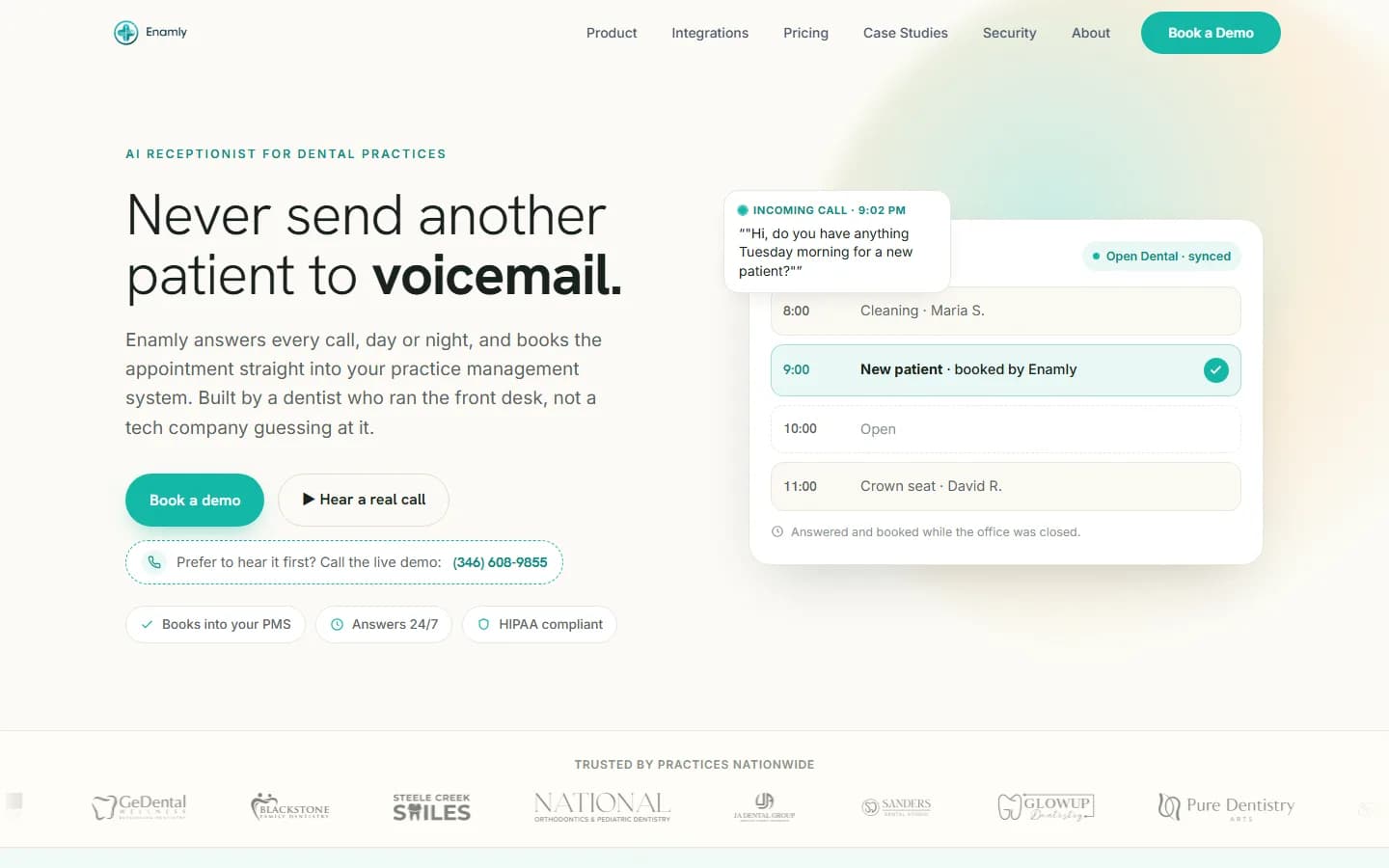
The telehealth automation we built is for a private client, so it is not shown here. This is a product website we built for an AI receptionist for dental practices. We built the website, not the AI receptionist.

FAQ

Questions from telehealth companies

Have you built this for a telehealth company before?

Yes. For a US telehealth company, a paying customer is now enrolled and booked without the owner stepping in. The client is private, so we don't name them or publish details here. We can talk it through on a call, with the client's agreement.

We already run on a telehealth platform. Do we have to replace it?

No. We usually work around the care platform, payment tool and form tool you have. What we can automate depends on whether each one lets other software read and write to it. We check that before we quote, and tell you if a step has to stay manual.

Can you tell us which states our clinicians can see patients in?

No. That is a question for your own legal or compliance adviser, and we don't give advice on it. You give us the rule for each clinician. We build booking that follows it, and make it easy for you to change when a licence is added or lapses.

What happens when a card fails or a patient cancels their plan?

You decide, and we build to that. A common setup tells the patient, tells your team, and keeps or releases the next visit as your policy says. Refunds and cancellations wait for a person on your team to approve them.

Do you do full telehealth app development, or only the sign-up flow?

Mostly the path from sign-up to first visit: the sign-up page, payment, intake, clinician matching and booking. We usually work around the care platform you already have and do not replace it. We also check and fix a patient app you started with an AI tool.

We built our patient app with an AI tool. Is it safe to launch?

We can't say until we've looked. We read the code, test sign-up, payment and booking with test patients, and give you a plain list of what to fix first. We also agree with you which rules apply to your patient data, and build to what the contract sets out.

  1. 1Map My Sign-Up Flow
  2. 2We reply within one business day
  3. 3Discovery call
  4. 4Step one: Sign up as a patient

Walk us through one sign-up, from card payment to first visit.

If you are the link between a patient's payment and their first visit, show us one sign-up from start to finish. We'll mark the steps that can run without you, and the ones that should stay with a person.

  • The first conversation is free
  • NDA before you share anything
  • A reply within one business day