Skip to content
Sun Software logo with the tagline Engineering Beyond Code
Therapy & Mental Health Practices

Therapist website design that gets each new client to the right person.

Someone looking for a therapist reads a few profiles, checks who has space and decides if they feel safe enough to write. Therapist website design has to earn that trust, so ours covers the profiles, first-session booking, private intake forms and waiting list that get them to the right person in your practice, without your team chasing emails.

What the research says

Clients are looking. Most therapists are full.

Surveys of psychologists in the US and therapists in the UK show how little space most practices have. A US study and a consumer survey show how people look for a therapist, and how often the listings they rely on are wrong.

  • of US psychologists surveyed said they had no openings for new patients

    53%

    What we do

    We build a waiting list that records what each person needs and offers a freed slot to the next match.

  • of UK therapists surveyed said demand at their practice was over capacity

    36%

    What we do

    We show on each profile if that therapist is taking new clients, and your team can change it themselves.

  • of answered or disconnected calls to US psychiatrists and psychologists in insurer directories turned up a wrong listing

    56%

    What we do

    We check your directory listings against your own site, and point each one to your own booking page.

  • of US consumers surveyed said they found their therapist through an online search

    23.5%

    What we do

    We build a page for each therapist that says who they work with, their approach and their session formats.

The problem

Where does a new client get lost before the first session?

Writing to a therapist for the first time takes effort. If the reply is slow, the therapist is full or the form feels exposed, many people don't try twice. You may recognise some of these in your practice.

01

Enquiries reach a therapist whose caseload is already full

02

Profiles don't say who each therapist works with, or how

03

A directory listing takes the enquiry, and you never see where it came from

04

The waiting list is a spreadsheet nobody has opened this month

05

Intake and consent forms go back and forth as email attachments

06

Late cancellations leave session slots empty that someone on the list wanted

One plan, several services

Who does what on your project?

For a new client, reading a profile, booking a first session and filling in a form are one decision about trust. So we plan them together, and each part of our team takes the piece it knows best.

  1. 1

    Web, Ecommerce & Digital Platforms

    Your site, therapist profiles, pages for each kind of therapy, and first-session booking.

  2. 2

    AI Agents & Business Automation

    Waiting list offers, session reminders and intake handoffs. Any AI stays on scheduling admin and hands over to a person.

  3. 3

    Custom Software & SaaS Development

    Private intake forms, a client area, and links to your practice management system.

  4. 4

    SEO, AI Visibility & Digital Growth

    Your Google Business Profile, directory listings and a findable page for each therapist.

First conversation

What we ask before we propose anything

Three questions show us where new clients stall and where your team spends its admin hours.

01

When someone enquires today, who decides which therapist they see, and how long does that take?

02

How many people are on your waiting list, and what happens when a regular slot opens up?

03

What do you ask a new client before the first session, and where do those answers end up?

How it works

How we work with your practice

We start with one new client and the first week after they find you. What may be asked, stored and seen is settled before we build any form.

  1. 01

    Trace one enquiry

    We follow a new enquiry from a search or a directory to the first session, and note each email, call and form on the way.

    What you get

    A map of the first week that your intake coordinator recognises.

  2. 02

    Settle what is asked and stored

    You tell us which rules and professional standards apply to your client data. We agree which questions go on which form, where answers are kept and who sees them. It goes into the contract.

    What you get

    A written list of forms, fields, storage and access.

  3. 03

    Write the profiles with your therapists

    Each therapist approves their own page. You supply the clinical wording, and we make it clear and easy to find.

    What you get

    Profile and service pages approved by the people named on them.

  4. 04

    Build booking, intake and the list

    We connect first-session booking, intake forms, the waiting list and reminders to your calendar and practice management system.

    What you get

    A working site on a private test copy.

  5. 05

    Test as a client, then hand over

    We book test sessions as a new client would, check the list of tags on every page, launch, and show your team how to open or close a therapist to new clients.

    What you get

    A site and a booking process your team can run.

What you get

What changes for your practice?

Here is what you, your intake coordinator and your therapists should notice. Exactly what you get depends on what we agree to build.

What we show as proof

We have not built for a therapy practice yet, so none of these points has been measured in your field. They come from how booking, forms and reminders work on the projects we do build. On Fiverr our work is rated 4.9 from 1,685 reviews, and 218 of those mention websites. Where a benefit has not been measured, we call it intended, not proven.

  • Enquiries reach a therapist with space. Clients see who suits them and who is taking new clients, before they write.

  • First sessions booked without email chains. A client picks an intro call or first session time and gets a confirmation.

  • Intake stays out of inboxes. Forms are filled in online and go to the system and the people you have named.

  • A waiting list that moves. When a slot opens, the next person it suits is offered it, and your team sees who accepted.

  • A list of what runs on each page. Every tag, pixel and widget is written down and approved by you, with booking and intake pages checked first.

Public cases

Three public cases from mental health services

These were reported by a US regulator and the press. None of them is our client. Each one shows a mistake we plan against.

  • Regulator action · 2023

    BetterHelp shared intake answers with ad platforms

    What happened

    The US Federal Trade Commission said the online counselling service BetterHelp used email addresses and health questionnaire answers for advertising, and revealed them to Facebook, Snapchat, Criteo and Pinterest. It had promised users it would keep that data private. The order required BetterHelp to pay $7.8 million.

    What we do about it

    We list every tag, pixel and widget on your site with you, starting with booking and intake pages. Intake answers go to your practice system, not to an advertising tool.

    Source: Federal Trade Commission, 2023
  • AI chatbot withdrawn · 2023

    A US helpline took its chatbot offline

    What happened

    The National Eating Disorders Association in the US announced it would close its staffed helpline and offer a chatbot called Tessa. Users reported that the chatbot gave dieting advice to people who had come for support. The association took it offline in May 2023.

    What we do about it

    We don't build AI that talks to your clients about their mental health. If you want an assistant, it answers scheduling questions only and hands over to a person.

    Source: CBS News, 2023
  • Data breach · 2020

    A Finnish therapy chain closed after its records were stolen

    What happened

    Vastaamo, a psychotherapy chain in Finland, had a database of client details and session notes accessed by intruders. In 2020 the records were published and clients received demands for money. An estimated 40,000 people were affected, and the company went into liquidation in 2021.

    What we do about it

    We agree with you in writing where client answers are kept and who can open them. Our starting point is that the website stores as little as possible and never holds session notes.

    Source: Bitdefender, 2021
Proof

Recent work

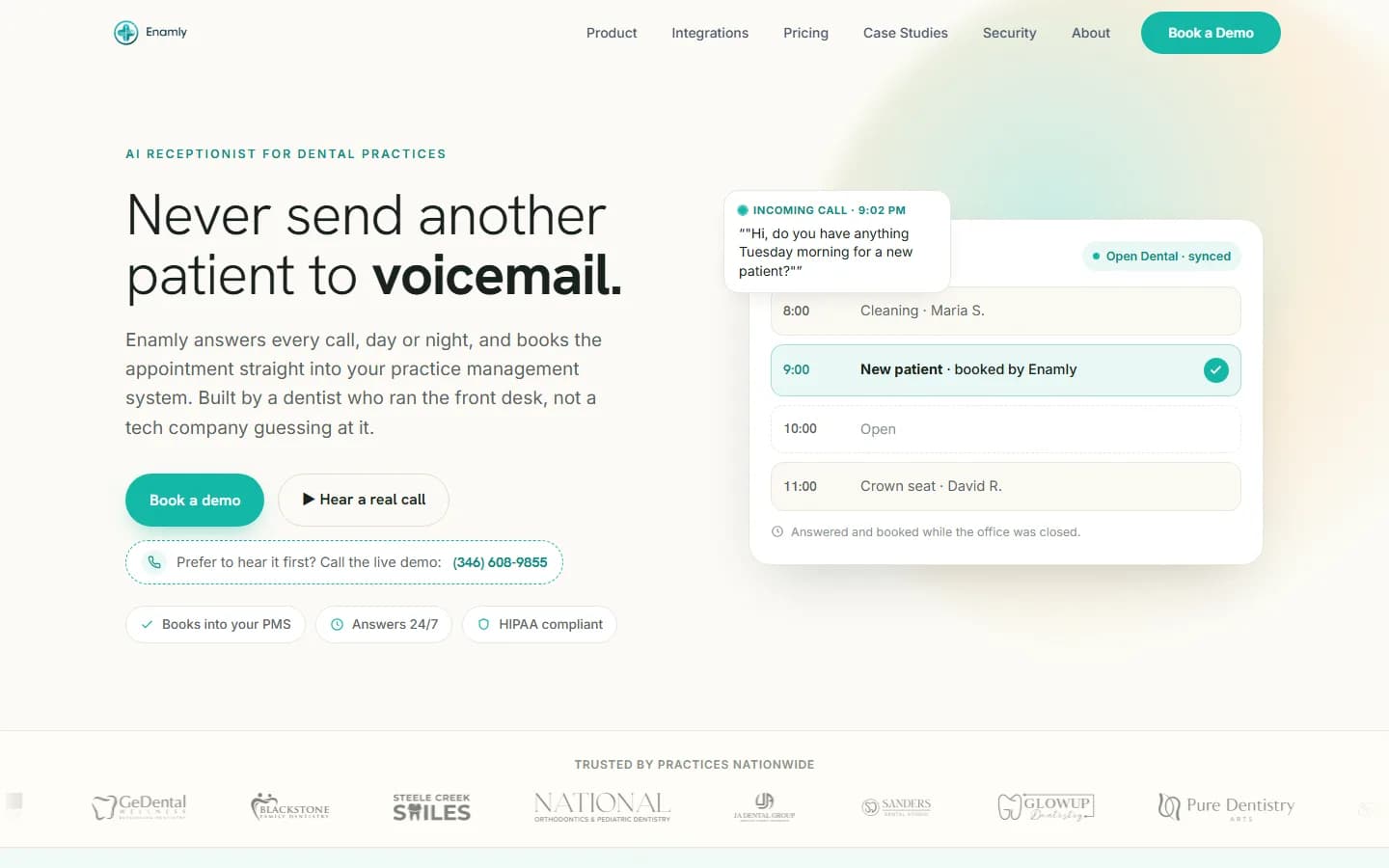
We have not built for a therapy practice. This is a product website we built for an AI receptionist for dental practices. We built the website, not the AI. Work for private clients is shown on a call, with the client's agreement.

FAQ

Questions from therapy practices

What does therapist website design include?

A profile page for each therapist, first-session booking that shows who has space, intake and consent forms filled in online, and a waiting list with reminders. Your therapists approve their own pages, and you supply the clinical wording.

Can clients choose their own therapist, or do we assign them?

Either, or a mix. Some practices let clients book straight from a profile. Others want an intake coordinator to review each enquiry first. You decide the rule, including which questions are asked, and we build booking to follow it.

Where do a client's intake answers go?

Where you and we agree in writing before the build. Our starting point is that answers go to your practice management system and are not kept in email or in the website's database. Which rules apply to your client data is your decision, with your own adviser. We build to what the contract sets out.

Should we stop using therapist directories?

Not necessarily. A directory can bring people who would not have found you. The risk is depending on a listing you don't control. We keep your listings accurate and point them to your own booking page, so you can see which ones bring enquiries.

Will an AI tool talk to our clients about how they feel?

No. We don't build that. If you want an assistant, it handles scheduling questions only, such as opening times, fees and how to book, and it hands over to a person. You approve what it may say, and we test it on real examples before it goes live.

Have you built a site for a therapy practice before?

No, and we would rather say so. We build websites, booking flows, private forms and automations for other kinds of business. For yours, we rely on you for clinical wording and professional rules, and we show you everything on a test copy before launch.

  1. 1Map My Client's First Week
  2. 2We reply within one business day
  3. 3Discovery call
  4. 4Step one: Trace one enquiry

Walk us through a new client's first week with your practice.

If new clients wait days for a reply, or your waiting list lives in a spreadsheet, tell us what happens after someone first writes to you. We'll map a shorter, more private path to the first session.

  • The first conversation is free
  • NDA before you share anything
  • A reply within one business day